Be yourself; Everyone else is already taken.
— Oscar Wilde.
This is the first post on my new blog. I’m just getting this new blog going, so stay tuned for more. Subscribe below to get notified when I post new updates.
Be yourself; Everyone else is already taken.
— Oscar Wilde.
This is the first post on my new blog. I’m just getting this new blog going, so stay tuned for more. Subscribe below to get notified when I post new updates.
Saying what’s in your heart…
Once again after a long break, I am back with another song to talk about. This time the song doesn’t belong to any Bollywood movie but is a Ghazal sung by the ‘king of ghazals’ Jagjit Singh ji.
‘Ghazal’ in themselves are a different genre of poetry altogether. Hard to translate the idea of a ghazal into English, which originated somewhere around 7th century CE from Arabic poetry and spread more prominently, in the middle East and Indian subcontinent with the advent of Sufism, from 12th century onwards.
Ghazals are mostly based on themes of passionate love, the grief of separation and (sometimes exaggerated) appreciation of beauty. It consists of couplets or ‘sher‘ which are connected with each other by a common theme but at the same time, are also independently holistic in their meaning. The words are laced with heavy emotions and so profound, that mere words can make you cry. To understand how powerful words can be, Ghazals are a prime example. They might sound ambiguous or even absurd at first hearing, but it takes time for the deeper meaning to sink in.
A ghazal conveys very strong emotions, and a ghazal in the mellifluous voice of Jagjit Singh, more so. The ghazal king has sung and composed hundreds of ghazals, all the while, bringing it to the forefront of Indian classical art forms by choosing relatable ghazals and simple melodies which became popular for this genre of music in India.
I chose this ghazal to translate because it describes an upsetting situation and possibly a heart-break. The feelings of sadness are profound, yet the words so simple. It is one of my favourite ghazals to listen to every time the heart gets spurned. The song is from one the most famous albums of Jagjit Singh, Saher (dawn). A very well-curated collection of ghazals from famous ghazal writers, and each one of the songs is a real gem.
As far as the current ghazal is concerned, not a lot is known or written anywhere about the writer of the ghazal. The writer’s name is given as Iqbal Azim, which according to my research, must be the Sayid Iqbal Azeem of Bengal fame. A famous Urdu poet and Urdu language scholar born in Meerut in 1913, who served as a professor in both Uttar Pradesh as well as Bangladesh. He died the same year when the album came out in 2000, and therefore could be thought of as a tribute to him.
The ghazal is melancholy and sad in its expression, although it refuses the use of strong words to express that deep grief. And that is where the beauty lies in this piece of poetry. The poet sounds quite hurt and innocent at the same time. The final couplet (called the ‘maqta‘), mentions the name of the poet, Iqbal, as a part of the poetry. This practice of mentioning the poet’s pen-name in the last couplet is known as Takhallus, which was adopted for the first time during the 12th century Persian Ghazal writing era and is known as one of the most significant modifications to ghazal writing contributed by Persian poets.
Listen to the soulful ghazal here. Translating this one has been the most challenging effort to date.
Male: Tumne dil ki baat keh di
Tumne dil ki baat keh di, aaj ye achchhaa hua
Tumne dil ki baat keh di, aaj ye achchhaa hua
Hum tumhe apna samajhate the, bada dhokha hua
Tumne dil ki baat keh di
English: You said what’s in your heart
You said what’s in your heart, today, it’s good that it happened
You said what’s in your heart, today, it’s good that it happened
I understood you as my own, it was a great deception that happened
You said what’s in your heart
Jab bhi hamne kuchh kaha, uska asar ultaa hua
Jab bhi hamne kuchh kaha, uska asar ultaa hua
Aap shaayad bhoolte hain, baarahaa aisa hua
Aap shaayad bhoolte hain, baarahaa aisa hua
Tumne dil ki baat keh di, aaj ye achchhaa hua
Tumne dil ki baat keh di
English: Whenever I said anything, an entirely contrary effect happened
Whenever I said anything, an entirely contrary effect happened
Perhaps you are forgetting that time after time, it happened
Perhaps you are forgetting that time after time, it happened
You said what’s in your heart, today, it’s good that it happened
You said what’s in your heart
Apki aankho me ye aansu kahaan se aa gaye
Apki aankho me ye aansu kahaan se aa gaye
Hum to deewane hai lekin aapko ye kya hua
ham to deewane hai lekin aapko ye kya hua
tumne dil ki baat keh di
English: These tears in your eyes, how come that it happened
These tears in your eyes, how come that it happened
I am anyway a crazy lover, but to you, what is it that happened
I am anyway a crazy lover, but to you, what is it that happened
You said what’s in your heart
Ab kisi se kya kahen, Iqbal apni dastaan
Ab kisi se kya kahen, Iqbal apni dastaan
Bas khuda ka shukr hai jo bhi hua achchhaa hua
Bas khuda ka shukr hai jo bhi hua achchhaa hua
Tumne dil ki baat keh di, aaj ye achchhaa hua
Hum tumhe apnaa samajhate the bada dhokha hua
Tumne dil ki baat keh di
English: Now Iqbal, what is the use of telling my tale to anybody, about whatever happened
Now Iqbal, what is the use of telling my tale to anybody, about whatever happened
Only God should be thanked, for it was all very good whatever happened
Only God should be thanked, for it was all very good whatever happened
You said what’s in your heart, today, it’s good that it happened
I understood you as my own, it was a great deception that happened
You said what’s in your heart
Glossary:
The ever-elusive beauty…
This time we travel back to the colour films era. A very low-budget and flop movie from 1997, Ghoonghat, starring Inder Kumar (quite unknown) and Ayesha Julka (I used to think she is the wife of Jackie Shroff for a long time, until I found out it is some other Ayesha). Rest of the star-cast includes veterans like Satish Kaushik, Gulshan Grover, Tiku Talsania and others.
A special mention of the two shortest actors in the movie is warranted. These two are the unknown supporting actors whose names are very difficult to find in the mention of the star-cast on other websites (including IMDb). You will not find their names unless you watch the movie but these two literally have brought life and dance to an otherwise dull movie. Omkar Kapoor (the child artist who debuted as an adult actor in the movie Pyaar ka Punchnama 2) and King Kong (a Tamil dwarf character actor). An odd pair of a kid and an adult (solely based on their short heights), they showcase some fluent and energetic dance moves which is a delight to watch.
This movie can be purely described as a comedy. Right from the beginning, till the anti-climax, this movie is full of physical comedy and most of the supporting cast is already well-famed in this genre. Ayesha Julka is one under-hyped comedy actress, who, surprisingly has very good comic timing and expressions (in some other movies as well). Nonetheless, her misfortune that she never got recognition for her talent in comic roles. Everything else works well in this movie except the main lead Inder Kumar. Apart from a handsome, he hardly brings anything more to the table. The movie could have been substantial if the male character could have been removed and it could have been focused on the struggles of a village girl coming to a big city. But then, the director was not trying to make a meaningful movie. Inder Kumar can be described in a single word: overacting. And that is what never led to him gaining any success in Bollywood. That too, if he could have taken it to the extreme, at least the movie could have been too good because it was too bad. And one could have still laughed at his serious scenes.
The story is quite simple, but in case you want to watch the movie and want to avoid any spoilers, do not read any further. Most of the movie is shot in a film set of a residential society in Mumbai where the protagonist and his friends have been living together and struggling to get success in the dream city. The residents have their own shenanigans going on at the same time. The story takes a turn when the female lead is found by our hero, while running away from some Rajasthani goons. This girl is always dressed up in Rajasthani style dresses (you start wondering how heavy must her bag be, that she was carrying while running) and becomes a maid for the bachelors who gave her shelter in this strange city. Being a female character, she does show a strength of character unwarranted from her role in the 90s. Helps all the guys in achieving success while handling all the household efficiently and haggling with all the nosy neighbours as well, all the while trying to avoid the goons.
The hero and heroine fall in love eventually (don’t ask me how) and when the neighbours try to get them married to each other, it turns out that they were already married to each other in their village. But the hero couldn’t realize it all this time, because he had left her on the first night of their marriage without lifting her eponymous ghoonghat (veil). A very bad print of the whole movie can be found on YouTube.
This is the title song of the movie with very simple words. It comes quite early in the movie while the girl is seen running away from the goons in ghoonghat and the guy sings his heart out in the night. The movie has a few other good songs but this is my favourite song. The USP of this song is the suave voice of Hariharan which makes it better than any ordinary 90s song and elevates it to another level. That is something only Hariharan’s magic can do. Listen to his smooth voice here.
Male: Ghoonghat mein chehra aap ka
Kuchh is tarah se kho gaya
Ghoonghat mein chehra aap ka
Kuchh is tarah se kho gaya
Jhagda hi jaise chand ka
Badalon se ho gaya
Ghoonghat mein chehra aap ka, kuchh is tarah se kho gaya
Jhagda hi jaise chand kaa, badalon se ho gaya
Ghoonghat mein chehra aap ka, kuchh is tarah se kho gaya
English: Inside the veil, your face
Got lost is such a way
Inside the veil, your face
Got lost is such a way
As if the moon itself got into a fight
With the clouds
Inside the veil, your face got lost is such a way
As if the moon itself got into a fight with the clouds
Inside the veil, your face got lost is such a way
Nazarein meri nazar se
Meri jaan zara milao
Koi geet main bana lu
Dhun aisi gungunao
Nazarein meri nazar se, meri jan jara milao
Koi geet main bana lu, dhun aisi gungunao
Suno… suno… leke tumhe apni bahon mein, ghoonghat main khol du
Dil keh raha hai kisi bhi tarah tera chehra main dekh lu
Jadoo… jadoo sa dil pe aap ki,
Ek hi nazar mein ho gaya
Jhagda hi jaise chand ka badalon se ho gaya
Ghoonghat me chehra aap ka kuchh is tarah se kho gaya
English: (Your) Eyes with my eyes,
My darling, let them meet
I will create a whole new song,
Please croon such a tune
(Your) Eyes with my eyes, my darling, let them meet
I will create a whole new song, please, croon such a tune
Listen…listen… after embracing you with my arms, let me lift your veil
(My) Heart is saying, whichever way possible, I could see your face
Magic…something like magic worked on (my) heart, with your
Just one glance only
As if the moon itself got into a fight with the clouds
Inside the veil, your face got lost is such a way
Kai bar maine socha,
Aur sochkar yeh jana
Bin dekhe hi tujhe kyun
Main ho gaya diwana
Kayi bar maine socha, Aur sochkar yeh jana
Bin dekhe hi tujhe kyun Main ho gaya diwana
Hello… hello… aise khafa si kyun baithi ho, ghoonghat ko odhke
Tumko milega kya itna batao to, dil mera todke
Ghoonghat haan aaaah
Ghoonghat nahi yeh aap ka
Dushman yeh mera ho gaya
Jhagda hi jaise chand ka, badalon se ho gaya
Ghoonghat mein chehra aap ka kuchh is tarah se kho gaya
Jhagda hi jaise chand ka, badalon se ho gaya
Ghoonghat mein chehra aap ka, kuchh is tarah se kho gaya
English: Many times I pondered over it
And then after thinking, (I) understood this
Without even having seen you, why
I became crazy in love
Many times I pondered over it, and then after thinking, (I) understood this
Without even having seen you, why I became crazy in love
Hello… hello… why are you sitting so upset, draped in your veil
At least tell me this much, what will you get out of breaking my heart
Veil haan aaaah
It is not simply your veil,
It has become my enemy
As if the moon itself got into a fight with the clouds
Inside the veil, your face got lost is such a way
As if the moon itself got into a fight with the clouds
Inside the veil, your face got lost is such a way
Glossary:
The sorrow of life…
After the lack of internet last weekend, I am back again with another song. This one is a melancholic song, but I decided to translate it last week after being not able to converse with the love of my life for about 48 hours continuously (probably that’s why the sad song). Internet does that to you, if you are in a long distance relationship. I cannot even begin to imagine how people used to maintain long-distance relationships before the advent of telecommunication. Next time if you hear the love story of your grandfather, be impressed because times were so different back then.
This here is a beautiful but sorrowful song from the 1948 movie Aag (Fire). This fire is the central theme of the whole movie and denotes many forms of fire, viz. the fire to achieve his dreams, the fire of love which burnt in his heart for this one girl since he was ten years old and finally the literal fire which burnt his face. The movie was released just one year after independence and you can see the beginnings of cinema. Most of the night time frames are too dark to clearly see anything, almost all of the movie is shot in indoor sets and the voices are quite nasal.

While trying not to give any spoilers, the movie is focused on the main character of Kewal (only) who fell in love with theatre at the age of ten and wanted to run a theatre company of his own with his childhood sweetheart, Nimmi. Nimmi left the town without even saying goodbye to him, and thus begins his whole life in search of Nimmi(s). So stuck is he in his love for ten year old Nimmi, that the next two girls which come into his life will also be called as Nimmi by him. He does fall in love with two more women, while imagining them as Nimmi, and yet none of them stays (just like Nimmi the kid). In one sentence you can summarize the movie as ‘3 Nimmis and Kewal‘.
Raj Kapoor plays the lead role and does really make some important comments on the contemporary education system of India, on how parents enforce their desires on their children without paying heed to their wishes, how theatre actors are viewed by the erstwhile society, the outrageous gender imbalance in higher education institutes at that time (one girl in a class of about 100 students), how girls used to be married off without their wishes or even a timely notice, how a woman and her family struggled in Punjab during partition and how little attention is given to the beauty of soul but more to physical beauty. And yet even after raising so many issues, the movie doesn’t emphasize on any of them at length. Nonetheless, you can discover the rise of the great showman Raj Kapoor, who will go on to address such burning social issues with utmost dedication and sincerity in his upcoming work.
The ladies, Kamini Kaushal (whom I have only seen in the roles of aunty or mother previously) and the gorgeous Nargis, are present to provide the quintessential glamour and melodrama to the story. My personal favourite character is the mother of Kewal. She mostly evades overly melodramatic acting (which was very normal in movies from this time), so much so, that at one point she gives such a dry unemotional response to Kewal’s father, I was close to bursting into tears with laughter. And yet, she does fall into the trap now and then. The movie doesn’t make sense at many points, the events sometimes occur too abruptly or inconsequentially, logic is also not the forte of the script writer and also at some points, you wonder: Is this really a movie? Or is it an abstract artistic performance? There are unexplainable dance sequences in hazy sets which might not have been necessary at all. And the biggest let down of the movie is that the central character is not lovable. You do not miss him on the screen and you do not feel close to him. Even though he doesn’t show any hateful characteristics, his personality just doesn’t enkindle enough pathos to ever relate to him or feel sorry for him. You can watch the whole movie on YouTube. Watch it to see a dashing and handsome Raj Kapoor without moustache (which hardly ever left him after this) and a beautiful and cute ten year old Shashi Kapoor (as young Kewal).
Coming to the song which is translated here, it has been a faithful companion to me in grievous times. Mukesh‘s melancholy voice is the epitome of expression of sadness. Kewal sings this song to lament the wedding of his beloved Nimmi (2nd one from college) to an NRI (big feat). The words from Behzad Lucknowi (must be from Lucknow) are a beautiful piece of poetry, very deep in their meaning and quite many heavy Urdu words. The song is quite long but once it starts, there are hardly any interludes and one stanza quickly comes after the other. The tune also is not very complicated. Enjoy the song.
Male: Zinda hun is tarah ki gham-e-zindagi nahin
Jaltaa hua diya hun magar roshani nahin
Zinda hun is tarah ki gham-e-zindagi nahin
Jaltaa huaa diya hun magar roshani nahin
English: I am alive in a way as if numb to the sorrow of life
I am a burning lamp but without any light
I am alive in a way as if numb to the sorrow of life
I am a burning lamp but without any light
Woh muddaten huyi hain kisise juda hue
Woh muddaten huyi hain kisise juda hue
Lekin ye dil ki aag abhi tak bujhi nahin
Zinda hun is tarah ki gham-e-
English: It has been a long time since I have been separated from someone
It has been a long time since I have been separated from someone
But this fire in my heart hasn’t extinguished yet
I am alive in a way as if numb to the sorrow
Aane ko aa chukaa tha kinara bhi saamne
Aane ko aa chukaa tha kinara bhi samane
Khud us ke paas hi meri naiyyaa gai nahin
Zinda hun is tarah ki gham-e-
English: Even though the shore had already appeared in front
Even though the shore had already appeared in front
My boat itself didn’t go close to it, of its own accord
I am alive in a way as if numb to the sorrow
Honthon ke paas aaye hasi kya majaal hai
Honthon ke paas aaye hasi kya majaal hai
Dil ka muamalaa hai, koi dillagi nahin
Zinda hun is tarah ki gham-e-
English: Smile might come close to my lips, how dare it?
Smile might come close to my lips, how dare it?
This is a matter of heart, not just any other jest
I am alive in a way as if numb to the sorrow
Ye chaand ye hawa ye fazaa sab hain madmast
Ye chaand ye hawa ye fazaa sab hain madmast
Jab tu nahin to in mein koi dilkashi nahin
Zinda hun is tarah ki gham-e-zindagi nahin
Jaltaa hua diya hun magar roshani nahin
Zinda hun is tarah ki gham-e-zindagi nahin
English: This moon, this air, this ambience, all are intoxicated
This moon, this air, this ambience, all are intoxicated
When you are not here, then there is no attraction in these
I am alive in a way as if numb to the sorrow of life
I am a burning lamp but without any light
I am alive in a way as if numb to the sorrow of life
Glossary:
An analysis and interpretation…
Parasite is a timeless Korean movie, released in 2019, which leaves you with a lot to think about. Having seen it recently, I tried to understand the ideas in depth and therefore pondered over it a lot. After having read many different forums about the interpretation of the movie, I felt that I had something to add to all the various interpretations, based on the teachings of our scriptures on how to lead a good life. One needs to absorb the most useful learnings from everything we see and experience, be it any form of art. Parasite also provides you with a very comprehensive and straightforward enlightenment: ‘How not to lead your life and how not to raise a family’.
Coming straight to the point, being another one of the good movies in recent time, which won the Oscars and it is, but naturally, a thought-provoking movie.
Many comments and discussions about this film talk about the disparity between the rich and the poor. How the rich people shown in the movie are the underlying reasons for all the events in the film. How, the main parasite in the movie are not the poor people who have been feeding off the rich family but also the rich family which is completely dependent on the lower class people to be able to maintain their lifestyle and live a normal life. Moreover, most of these discussions spill over into the good old debate between the communist and capitalist ideologies. I, being a person who neither understands any of these “isms”, nor is much familiar with the world cinema, just wanted to express my views, which might be perceived as most people as very fundamental and mundane.
Acting as a devil’s advocate, as mentioned already, people have explained that how every character in the movie is a parasite. To me it seems that the main protagonist family is the poor Kim family, while the Park family is more of a backdrop since we never understand them and their thoughts in depth. So they are rich, but how shallow are they or what do they think of other people, what do they think of poor people? Do they believe in humanity, do they see humans as humans without class discrimination? This all is not clear from the movie. Therefore, I will focus on what I understand about the Kim family and what I think the movie teaches us with their example. All what I see from this movie is that parasites feeding off of hosts is a natural phenomenon, these parasites and hosts come from various species in the animal and plant kingdom, be it a worm inside a fruit or an amoeba in our body. Parasitic relationships are a part of nature all around us and the same applies to human societies as well. In a similar light, I see that the poor Kim family has parasitism in its very genetic make up. Why?
Let’s then try to ask some questions to understand this:
1. What are the moral values and ethics, which these poor parents had imparted to their children?
2. What did these poor parents know about earning money, about saving money and about spending money? Did they teach anything in that context to their kids?
3. What did the parents know about hard work and what did they convey to their children?
If you think about it, the parents themselves don’t know how to earn money the right way as well as how to spend their money in the right way. They do not seem to be knowing much about hard work and diligence, but are always trying to get by their days constantly, making efforts to find a shortcut to money. Even though the son of the Kim family got into the Park’s house fraudulently, he started to earn good money right from the beginning. By the time his sister joined him as well, they must have been making more money than they usually did. And yet they don’t know how to invest it or use it wisely because they just don’t know. That is something which is not in their value system. This is evident from the scene when the sister was taking the money out from the ceiling during heavy rain. Wads of money which were of no use. Even after the whole family started working for this rich family and even when they must be properly earning enough to be able to rent a good house, they didn’t do it. These are things which made me think of them as parasites through their genes. Even though a parasite gets enough food from the source, they neither start living on their own nor stop sucking food from the source, because they are just not programmed for it.
Even in the last segment of the movie, when they escaped from a situation where they were almost caught by the Park’s family, they don’t want to take this as a learning and to start a new life with the money they had already earned. Instead of trying to improve their life style, which didn’t even occur to them ever because they are parasites, they get angry at their employer for starkly observable things such as bad stench of their clothes due to the place they had been living in. If you think about it, even poor people can live in a clean and hygienic way to the best of their abilities (cleanliness is something you will never find in their house), more so when you start earning enough money.
As usual in the nature also, at the end of the day when two parasites fight with each other, of course the host is the one who is always on the losing side. Furthermore, in any ecosystem, if the source or host lets the parasite grow on it for too long, it is bound to get affected by the parasite. The parasite consumes something which is lost to the host at the end of the day. Because becoming a host involves a lot of hard work and dedicated efforts through many generations to be able to reach a state of abundance, which is going to be lost due to the parasite, but for the parasite, it has, anyway, been living this parasite life. Even if you offer them all the resources in the world, there is no way the parasites could step up to the next level unless otherwise they cultivate the right values in their family through moral education and exemplary ethical conduct. Wisdom and moral values, ultimately have nothing to do with one’s economic status. A poor person could be good or bad and so can a rich person be as well. Everything depends on the kind of education you receive. The right kind of education is the one which lets you see things for what they are, without bias and discrimination and teaches you how to lead a proper life. In the words of Tiruvalluvar, from one of the best treatise on life, i.e. Tirukkural:
Tamil
-திருவள்ளுவர்
கண்ணுடையர் என்பவர் கற்றோர் முகத்திரண்டுபுண்ணுடையர் கல்லா தவர். (௩௱௯௰௩)
Hindi
-तिरुवल्लुवर
कहलाते हैं नेत्रयुत, जो हैं विद्यावान। मुख पर रखते घाव दो, जो है अपढ़ अजान ॥ (३९३)
Sanskrit
-तिरुवल्लुवरः
चक्षुष्मन्तस्त एव स्यु: ज्ञानचक्षुर्युतास्तु ये। इतरेषामुभे नेत्रे व्रणे स्यातां मुखोत्थिते ॥ (३९३)
English
-Tiruvalluvar
The erudite have eyes; the ignorant have on their faces, two gashes. (393)
Love is not a game…
This week we come back to colour films finally. This is the title song from the movie ‘Pyar koi khel nahi‘ (Love is not a game), released in 1999. I like the music of the song although the movie is quite inconsequential and didn’t create any buzz on the box-office. With a meagre 3.3 out of 10 on IMDb (not surprised), I wouldn’t even recommend watching it and therefore won’t even share any YouTube link for the movie. It is just a mix of typical Sunny Deol action stuff with some romance strewn around, a tragedy, a love triangle, a beautiful show-piece female lead and some villains. And there you have it! Everything you need for a successful Bollywood movie (not all the time).
The star cast is not impressive. Apoorva Agnihotri was always too cute to be a full-blown hero in Bollywood (also, over-acting). Mahima Chaudhary is beautiful as always and Sunny is as tough as always. The story starts as a love triangle when two brothers are both in love with the same girl, she loves the younger one and finally marries him. But the younger brother dies in an accident (you know why) and the family motivates her to marry the older brother, coz otherwise how can you ever raise a kid on your own in this society (surprise, surprise)! So she marries the older brother, who was anyway not over her yet. And can you believe it! The younger one was alive all this time and he returns back. The elder one goes on to take revenge, for his brother, from the bad guys and dies in the process leaving the guy and girl to live happily ever after. That’s 90’s love for you. If you are the character in the movie whose love was unrequited all through the story, you should either die at the end (coz you can only love once) or if the story-writer is benevolent enough, he or she will provide you with an equally beautiful girl after the climax of the movie.
Coming back to the song, who doesn’t love the voice of Kumar Sanu! And the music of the song is pleasant, the tunes are catchy, the words are simple but lyrics are kind of negative when they describe love. According to this song, being in love is a very precarious situation and you shouldn’t jump into it just for fun. Think of this song as more like a warning, which also tells you at one point that to die in love is to be immortal. So even if you get annihilated in love, embrace this opportunity (ironic much!).
The song is from the perspective of Sunny Deol in love (actually just a strong crush) with Mahima Chaudhary, who works under him in his office. If you pay attention, you would think if the situation was anywhere close to reality, his character would be surely dragged into the #metoo movement, given his uncomfortable long stares towards Mahima, every time he sees her. And he does it unabashedly, without ever thinking that it might not be appropriate. But then that was Bollywood back then, romaticizing everything unromantic, right from eve teasing and staring to stalking. And this one is no different. Have a look at the video here, just enjoy the music and the lyrics.
Male: Jahaan mein koi pyaar ka
Deewana ho gaya jahan
Jeene marne ka hosh
Hai phir usse kahan
Pyaar koi khel nahin
Pyaar koi khel nahin
Jahaan mein koi pyaar ka, deewana ho gaya jahan
Jeene marne ka hosh, hai phir use kahan
Pyaar koi khel nahin, pyaar koi khel nahin
English: In this world, whenever somebody
becomes crazy for love
To die or to live,
In no way, he is left with that consciousness
Love is not a game
Love is not a game
In this world, whenever somebody becomes crazy for love
To die or to live, in no way, he is left with that consciousness
Love is not a game, love is not a game
Aashiqi woh rog hain
Ke lage jo ik baar
Dil se phir ye jaaye na
Kar ye jatan hazaar
Tere labon par bhi, pyaare
Rona hain ye hasee nahi
Jahaan mein koi pyaar ka, deewana ho gaya jahan
Jeene marne ka hosh, hain phir usse kahan
Pyaar koi khel nahin, pyaar koi khel nahin
English: Love is such a disease,
That if you catch it once,
From your heart, it will never leave,
Even if you make thousands of efforts
On your lips as well, darling
This is a cry, not a smile
In this world, whenever somebody becomes crazy for love
To die or to live, in no way, he is left with that consciousness
Love is not a game, love is not a game
Ishq mein koi bhi ho
Majnu ya Farhaad
Mit gaye shaahon ke naam
Par ye zinda hain aaj
Chaahat mein di jaan jisne
Woh kabhi marta nahi
Jahaan mein koi pyaar ka, deewana ho gaya jahan
Jeene marne ka hosh, hai phir use kahan
English: Whoever was ever in love,
Majnu or Farhaad
Names of kings have been erased,
But they are alive still today
Whoever gave (his or her) life in love,
He never dies
In this world, whenever somebody becomes crazy for love
To die or to live, in no way, he is left with that consciousness
Jahaan mein koi pyaar ka, deewana ho gaya jahan
Jeene marne ka hosh, hain phir usse kahan
Pyaar koi khel nahin, pyaar koi khel nahin
English: In this world, whenever somebody becomes crazy for love
To die or to live, in no way, he is left with that consciousness
Love is not a game, love is not a game
Glossary:
Song of the heart…
This time we travel even further back in time to 1949, to translate a song from the movie ‘Dulari‘ (beloved). As the name suggests, the movie is female centric (surprisingly) even though the female lead of the movie is just shown as an ill-fated weakling who does at times try to runaway from her suppressors but fails to do so by herself. A man at the end does come to her rescue due to which she finally is able to reunite with her long-lost family.
Dulari has the typical old Bollywood feel of dialogue delivery and songs sung in a nasal voice. Every character acts with heightened melodrama, which to today’s movie lovers might even seem comical at times. But that was just the beginning of Bollywood and thus we can let this one slide. It was a time when movies used to have hand-painted posters for advertisements. These posters now are heritage stuff, just like old time music records. I personally think they are worth cherishing (if you ever find an original one, please do tell me).
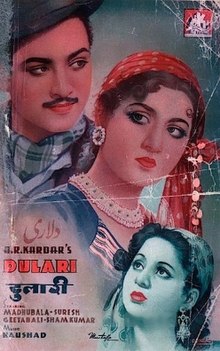
As you might have already understood from the poster, the female lead Dulari is played by the most beautiful lady of the silver screen, Madhubala and the actor is Suresh, whom I’ve never encountered or heard of before watching this movie. Geeta Bali is in a supporting role along with some other unknown names (you might find more on IMDb). The movie was a box-office hit and does have some famous songs from Naushad. I do not find anything worth mentioning about the movie, which shows a somewhat frightful time when city kids could be easily kidnapped by nomadic Banjara’s. That is the whole gist of the movie which only shows two classes of a freshly independent Indian society: the rich upper class and the nomadic tribals. And at the end how these both classes might perceive each other, the rich business man calls the tribals as shameless, vulgar, uncivilized people and the tribals talk of the rich city men as a living walking bag full of money. The suppression of women by both the classes is also quite evident. However, to listen to those nasal voices and dramatic dialogue delivery (which is an experience in itself), you can watch the whole movie on YouTube.
Let’s come back to the song now. The song is very short and laden with easy Urdu words with a very simplistic tune, sung by the nightingale of Bollywood Lata Mangeshkar and set with tunes by one of the most famous music directors of all time Naushad. It is a happy song sung by Dulari in the throes of love with dreams of a wonderful future life while she awaits her lover to make preparations for their marriage. It seems that no choreographer was hired for the movie (probably that was the norm at that time), as Madhubala lazily swings her arms and moves around in every song. You might say that was her whole idea of dance in the movie, to look pretty and dainty and nothing more than that (but then I would say, wasn’t this her dance style in almost every song ever filmed on her). And why not, Madhubala is beautiful enough to be able distract you from her lack of dancing skills! Enjoy the song here.
Female: Mohabbat hamari
Zamana hamara
Tu gaye ja aye dil tarana hamara
Mohabbat hamari, zamana hamara
Tu gaye ja aye dil tarana hamara
Mohabbat hamari
English: Love is ours
The era (or world) is ours
You, o heart, keep singing the songs of ours
Love is ours, the era (or world) is ours
You (my) heart keep singing the song of ours
Love is ours
Rahenge sada ham khushi ke chaman mein
Rahenge sada ham khushi ke chaman mein
Milega naa gham ko thikana hamara
Milega naa gham ko thikana hamara
Tu gaye ja aye dil tarana hamara
Mohabbat hamari
English: We will reside forever in the garden of happiness
We will reside forever in the garden of happiness
Sorrow will never find the address of ours
Sorrow will never find the address of ours
You, o heart, keep singing the song of ours
Love is ours
Ooooooooooo Hasin hai mohabbat hamare hi dam se
Ooooooooooo Hasin hai mohabbat hamare hi dam se
Naa bhulegi duniya fasana hamara
Naa bhulegi duniya fasana hamara
Tu gaye ja aye dil tarana hamara
Mohabbat hamari
English: Ooooooooooo love is beautiful only because of our might
Ooooooooooo love is beautiful only because of our might
The world will never forget the love story of ours
The world will never forget the love story of ours
You, o heart, keep singing the song of ours
Love is ours
Ham iss zindagi ko ujadane naa denge hoooooooo
Ham iss zindagi ko ujadane naa denge hoooooooo
Yahi zindagi hai
Yahi zindagi hai
Yahi zindagi hai khazana hamara
Tu gaye ja aye dil tarana hamara
Mohabbat hamari
Tu gaye ja aye dil tarana hamara
Mohabbat hamari
English: We will not let this life get ruined hoooooooo
We will not let this life get ruined hoooooooo
This life only is
This life only is
This life only is the treasure of ours
You, o heart, keep singing the song of ours
Love is ours
You, o heart, keep singing the song of ours
Love is ours
Glossary:
Why names and numbers matter in your life?
Everyone is eager to know about the future. The purpose of search for our future is lucrative for almost everybody because if the future is known, then we can accordingly act with care. In our lifetime, we hear our own name a lot of times and that has a certain energy of vibration.
How? Do you believe that sounds change your emotions? Take a trivial mundane example: when somebody calls you by the name which you don’t desire to hear, your mood will transform for the worse. Conversely, when you get to talk to your loved ones after a long long time, do you feel that it has uplifted your spirits? Do you believe that people take decisions differently when they are in different moods, like the kind of decisions you take when you are angry, when you are sad, when you are happy are all very different. How do you think these decisions affect the aftermath of your life? According to the science of numerology, every sound and letter has vibrations which affect you and and how you take your decisions and our life is all about decisions that we make.
It’s just not only your name or the sounds around you, but also the date and time when you were born has given a certain vibration to you. The question then is how those vibrations work with your own name and with the people around you and the places in your surroundings. Of course everything around you has got vibrations and energies of their own.
In numerology, our benefits are determined by our date of birth. Benefits are characterized by the relationships between the nine planets in astrology and the numbers from 1 to 9.
Mathematical sciences, medical sciences, astrology and mantras (ancient Indian chants) spread to countries like Egypt and Persia only from India. In order to protect these arts and sciences from dying out, the ancient Egyptians painted and sculpted them in the pyramids. Now out of the 108 numbers given in the Indian science of numerology, only 78 of them can be seen in the pyramids. The facts regarding the remaining 30 never crossed the Indian borders. After king Solomon, Pythagoras, understood its importance and taught numerology to his disciples. He chose only those who were intelligent and had studied some of the arts under his guidance. Those who wished to become his disciples had to live initially with him in total silence for a period of three years. If they happened to speak even once, they were expelled. Thus, many were sent away for having expressed their own opinion, forgetting their vow of silence. This might seem ridiculous to those who think that they can get all their knowledge by reading books alone. Pythagoras’s disciples who learned to observe silence, became great thinkers, and that is enough about its history for now.
If numbers are excluded, then there is nothing in the world. Each English alphabet has its equivalent numbers. Despite the length of the name, lucky numbers, lucky days, lucky planets and benefits are determined and calculated by the total numbers of the name. Also by totalling the day, month and year in the date of birth, benefits are calculated. Good tree gives good fruits and a bad tree gives bad fruits. In the same way good numbers give advantages and bad numbers give disadvantages.
Numerological readings comprise of three different numbers affiliated with each individual. These are:
Psychic Number: This number is calculated using the birth date of the person. It puts emphasis on how an individual looks at himself, what views he or she has about himself and what characteristics he or she exhibits. It also signifies the talent that the individual holds apart from how he or she communicates with the people around him or her.
For example, if the birth date is 18th June, then as per the calculations, the psychic number is 1+8 = 9. Therefore, the psychic number for this person will be 9.
Destiny Number: This number is calculated by adding all the numbers in the full birthdate of the person. This puts emphasis on how the individual is looked at by the world and what view does the world have of him, as a person. This number is also affiliated with the vibrational patterns related to one’s past Karma or actions and as time passes by, one takes on the characteristics of his or her destiny number through experiences in life. The number ranges from 1-9.
For example, if the birthdate of a person is 18th June, 1992, then the destiny number of that person will be the total addition of the all the numerals in the month, year and date:
18-06-1992 = 1+8+0+6+1+9+9+2 = 36 = 3+6 = 9
Therefore, the destiny number of the person with this birth date will be 9.
Name Number:This number is arrived at, by using complex mathematical calculations based on the frequency of the sound that is related to a particular number. This puts emphasis on the relationship that the person has with the other people. One can have multiple name numbers if they are called by different names and thus by changing your name you can have a variety of name numbers which may prove to be beneficial depending on what name you use. It is said that certain name numbers can also have a positive impact on the destiny and the psychic numbers or can help in removing any contrast between the two. This number also ranges from the digits 1 to 9 in numerology and holds a lot of importance as it helps in knowing and building relationships with others around you.
The numbers and the letters are the two eyes of human beings.
-Thiruvallular
Since this article is written only to give a glimpse of what numerology is but not a research thesis on this subject, we are stopping at this. If anybody wants to know the absolute fundamentals of numerology, I would like to suggest them to read “AINTHIRAM” which is the only one and probably the foremost books written, an extremely long time back, by MAYAN and explains the science behind it.
For a free numerology consultation or more information, please contact at our email: aaten84@gmail.com. Consultation will be given if and only if we find out (using your numbers) that it can bring a positive change in your life.
Tread lightly into these eyes…
This week, we are travelling far back in time. A time when whole movies used to be shot on a movie set, akin to a theatre performance. A time when background music was not so high-tech, nor the musical instruments were too advanced and complicated. A time when a simple-looking, short guy without chiselled abs could still be the main lead actor and the movie could still be a super-hit. A time when dances were probably carried out without properly choreographed moves (notice the dance in the songs).
Albela (strangely unique) is all that and more. A box-office super-hit of 1951, it was the biggest success in the acting career of Bhagwan Dada. An average looking man who rose from being the son of a mill worker into a self-made director, producer and actor. Along with Geeta Bali, this movie was one with a social message, as per the advise of Raj Kapur, which has some of the most iconic Bollywood songs of all time. It is a full-blown musical (12 songs in total, literally the movie breaks into songs at the most abrupt moments) and a feast for movie-making history lovers. In case you wish to see the origin of all those bombastic forever songs, you can watch the whole movie on YouTube. You might feel though that half of the movie is songs.
The story is quite simple. Pyarelal (Bhagwan dada) comes from a very poor family, struggling to gather money to get the youngest daughter (Pyarelal’s sister) married. Under such stressful circumstances when Pyarelal loses his job due to his dreams of becoming a theatre actor, the father gets into a huge argument with him and he leaves the house with the promise to come back only when he becomes a famous actor. Eventually he comes back after getting success and a girlfriend (Geeta Bali) but things have gone topsy-turvy at home (spoiler much!). The movie tries to showcase the state of women in terms of lack of education and employment opportunities, dowry demands and a general non-existence of the word ‘women empowerment‘ (I hardly think it was the keyword at that time). The movie does showcase social problems, but does it provide any solution? No, Not even a clear comment. For that you obviously will have to turn to Raj Kapur‘s movies.
Back to this song. Based on the beautiful Raga Piloo, there are three different versions of this song in the movie. Two female versions, happy and sad, sung by Lata Mangeshkar ji and one male version sung by C. Ramachandra. Here I am translating the happy version by Lata didi, which is in the form of a lullaby. One of the earliest Bollywood lullabies, it is so soothing to listen to, that you might actually fall asleep with it. The lyrics give the feel of a colloquial Hindi dialect and are quite simple. Might translate the sad version some other time. The male version has the same lyrics as the happy female version.
Female: Dheere se aaja ri ankhiyan mein
Nindiya aaja ri aaja
Dheere se aaja
Dheere se aaja ri ankhiyan mein, nindiya aaja ri aaja
Dheere se aaja
English: Come treading lightly into the eyes
Sleep please come, please come
Come treading lightly
Come treading lightly into the eyes, sleep please come, please come
Come treading lightly
Chupke se nainan ki bagiyan mein, nindiya aaja ri aaja
Dheere se aaja
English: Secretively into the garden of eyes, sleep please come, please come
Come treading lightly
Ho o o o
Ho o o o
Lekar suhaane sapnon ki kaliyaan
Sapnon ki kaliyaan
Lekar suhaane sapnon ki kaliyaan
Aake basade palkon ki galiyaan
Palkon ki chhoti si galiyan mein
Nindiya aaja ri aaja
Dheere se aaja
English: Ho o o o
Ho o o o
Bringing along the buds of charming dreams
Buds of charming dreams
Bringing along the buds of charming dreams
Come and populate the lanes of eyelids
Into the tiny lanes of eyelids
Sleep please come, please come
Come treading lightly
Dheere se aaja ri ankhiyan mein, nindiya aaja ri aaja
Dheere se aaja
Chupke se nainan ki bagiyan mein, nindiya aaja ri aaja
Dheere se aaja
English: Come treading lightly into the eyes, sleep please come, please come
Come treading lightly
Secretively into the garden of eyes, sleep please come, please come
Come treading lightly
Ho o o o
Ho o o o
Taaron se chhupkar, taaron se chori
Taaron se chori
Taaron se chhupkar, taaron se chori
Deti hai rajni chanda ko lori
Hansta hai chanda bhi nindiyan mein
Nindiya aaja ri aaja
Dheere se aaja
English: While hiding away from stars, stealing from the stars
Stealing from the stars
While hiding away from stars, stealing from the stars
Night gives (sings) a lullaby to the moon
The moon too, laughs in his sleep
Sleep please come, please come
Come treading lightly
Dheere se aaja ri akhiyan mein, nindiya aaja ri aaja
Dheere se aaja
Chupake se nainan ki bagiyan mein, nindiya aaja ri aaja
Dheere se aaja
English: Come treading lightly into the eyes, sleep please come, please come
Come treading lightly
Secretively into the garden of eyes, sleep please come, please come
Come treading lightly
Glossary:
An ode to her.
Here I am back with a very old song sung by one of the most melancholy voice of Bollywood playback, Mukesh. Mukesh is well-known for singing sad songs beautifully, but once you listen to this one, you will feel that he does justice to even romantic songs equally.
The song is from the 1963 movie ‘Phool Bane Angarey‘ (Do not confuse it with Rekha‘s bold movie by the same name from 1991). A typical car song from Bollywood, where the landscape keeps moving behind a stationary car, this is when Rajkumar praises Mala Sinha‘s beauty. It does actually make you believe that she is so gorgeous, not that she wasn’t but the lyrics do have a psychological effect on one’s perception. To many who are not familiar with the Hindustani style of poetry (a mix of Hindi and Urdu), it might seem like an outrageously exaggerated description. But this is the essence of romantic poetry in North India, which is a progeny of Arabic, Persian, Urdu and Hindi poetry. For a lover, to be able to create odes, describing the beauty of his beloved in the most superlative forms, was the highest form of reverence for his love. Somehow, worship and love are synonymous in this culture, which might be the topic for another blog post.
More about the song. I did find some other English translations for the song but nothing pleased me completely. Therefore, I decided to pay my own tribute to this genius penmanship of Anand Bakshi. For the native speaker, the song paints a dreamy canvas of similes and metaphors regarding the beauty of the lady. At places it brightens up and at places it becomes too delicate. At moments you might find that the painting is too fragile, while at others you feel the strength and depth of the female character as well. Words are mostly Urdu, the tune is quite repetitive and uncomplicated. All the complicacy comes to this song, courtesy of the lyrics. If you ever want to learn how to romance with just words, you need to learn Urdu. Feel free to listen to the song for that quintessential black and white car sequence from an old movie and for gorgeous Mala Sinha.
Male: Chand aahen bharega
Phool dil thaam lenge
Chand aahen bharega
Phool dil thaam lenge
Husn ki baat chali to
Sab tera naam lenge
Chand aahen bharega
English: The moon will heave sighs
The flowers will hold on to their hearts
The moon will heave sighs
The flowers will hold on to their hearts
Whenever there is a talk of extreme beauty
Everybody will take your name
Aisa chehra hai tera, jaise roshan sawera
Jis jagah tu nahin hai, us jagah hai andhera
Aisa chehra hai tera, jaise roshan sawera
Jis jagah tu nahin hai, us jagah hai andhera
Kaise phir chain tujh bin, tere badnaam lenge
Kaise phir chain tujh bin, tere badnaam lenge
Husn ki baat chali to, sab tera naam lenge
Chand aahen bharega
English: Your face is like that, as if a bright morning
Wherever you are not, that place is filled with darkness
Your face is like that, as if a bright morning
Wherever you are not, that place is filled with darkness
How then respite without you, will your infamous take
How then respite without you, will your infamous take
Whenever there is a talk of extreme beauty, everybody will take your name
The moon will heave sighs
Aankhen naazuk si kaliyan, baat misri ki daliyan
Honth Ganga ke saahil, zulfen jannat ki galiyan
Aankhen naazuk si kaliyan, baat misri ki daliyan
Honth Ganga ke saahil, zulfen jannat ki galiyan
Teri khatir farishte, sar pe ilzaam lenge
Teri khatir farishte, sar pe ilzaam lenge
Husn ki baat chali to, sab tera naam lenge
Chand aahen bharega
English: Eyes like delicate flower buds, talks like lumps of sugar
Lips the banks of Ganga, tresses the lanes of paradise
Eyes like delicate flower buds, talks like lumps of sugar
Lips the banks of Ganga, tresses the lanes of paradise
For your sake (even) angels will take (any) blame on their heads
For your sake (even) angels will take (any) blame on their heads
Whenever there is a talk of extreme beauty, everybody will take your name
The moon will heave sighs
Chup na hogi hawa bhi, kuchh kahegi ghata bhi
Aur mumkin hai tera, zikr kar de Khuda bhi
Chup na hogi hawa bhi, kuchh kahegi ghata bhi
Aur mumkin hai tera, zikr kar de Khuda bhi
Phir to patthar hi shaayad, zabt se kaam lenge
Phir to patthar hi shaayad, zabt se kaam lenge
Husn ki baat chali to, sab tera naam lenge
English: The breeze will also not be silent, the clouds will also say something
And it is possible that God might also mention you
The breeze will also not be silent, the clouds will also say something
And it is possible that God might also mention you
In that only stones perhaps, will be able to exercise restrain
In that only stones perhaps, will be able to exercise restrain
Whenever there is a talk of extreme beauty, everybody will take your name
Chand aahen bharega, Phool dil thaam lenge
Husn ki baat chali to, sab tera naam lenge
Chand aahen bharega
English: The moon will heave sighs
The flowers will hold on to their hearts
The moon will heave sighs
The flowers will hold on to their hearts
Whenever there is a talk of extreme beauty
Everybody will take your name
The moon will heave sighs
Glossary:
Thinking fast and slow by Daniel Kahneman
Here is the summary of a bestseller written by Daniel Kahneman. Enjoy reading.
Our decision making is governed by two different thinking systems:
1. System one- Fast, intuitive, feeling based system
2. System two- Slow, reasoning based system
“When we think of ourselves, we identify with System two. The conscious, training self that has beliefs, makes choices, decides what to think about and about what to do.”
-Daniel Kahneman
Even though system two believes that it is controlling our lives, it is actually system one which controls our life, more than we can realize.
“System one originally originates impressions and feelings that are the main sources of the explicit beliefs and deliberate choices of system two…(system two) is the secret author of many of the choices and judgments you make”
-Daniel Kahneman
Three fundamental ways by which system one (the fast thinking system) makes costly decisions are:
1) Frequent exposure bias
“A realistic way to make people believe in falsehood is repetition, because familiarity is not easily distinguished from truth. Authoritarian institutions and marketers have always known this fact“
-Daniel Kahneman
To challenge the Frequent exposure bias and to exercise free will, we must pause before an important decision and ask ourselves “Is this the best option I’ve been frequently exposed to?“
2) Status quo bias
System one of our brain is biased towards status quo because system one psychologically weighs losses twice as much as gains (loss aversion). System one is emotionally attached to objects it owns or invests in (endowment effect) and over values the status quo.
To challenge the status quo bias, we should ask ourselves “What opportunities do I lose by maintaining the status quo?”
3) Tunnel vision
System one loves to use limited information to form a quick judgment and blocks out all the conflicting information. You can call it tunnel vision, but the author calls it W-Y-S-I-A-T-I (what you see is all there is) system. This system sees one or more informations and then “infers and invents causes and intentions, then neglects ambiguity and suppresses doubt“.
To confront the tunnel vision bias we must ask ourselves “Why might the opposite be true?”
“MAINTAINING ONE’S VIGILANCE AGAINST BIASES IS NOT A CHORE BUT A CHANCE TO AVOID THE COSTLY MISTAKES WE MAKE, WHICH IS SOMETIMES WORTH THE EFFORT”
-Daniel Kahneman
Here is a link of the book: https://www.amazon.com/dp/0374533555/ref=cm_sw_r_cp_awdb_t1_fZGHEb64433GX
Happy reading!

 The Heritage Chutney