Song of the heart…
This time we travel even further back in time to 1949, to translate a song from the movie ‘Dulari‘ (beloved). As the name suggests, the movie is female centric (surprisingly) even though the female lead of the movie is just shown as an ill-fated weakling who does at times try to runaway from her suppressors but fails to do so by herself. A man at the end does come to her rescue due to which she finally is able to reunite with her long-lost family.
Dulari has the typical old Bollywood feel of dialogue delivery and songs sung in a nasal voice. Every character acts with heightened melodrama, which to today’s movie lovers might even seem comical at times. But that was just the beginning of Bollywood and thus we can let this one slide. It was a time when movies used to have hand-painted posters for advertisements. These posters now are heritage stuff, just like old time music records. I personally think they are worth cherishing (if you ever find an original one, please do tell me).
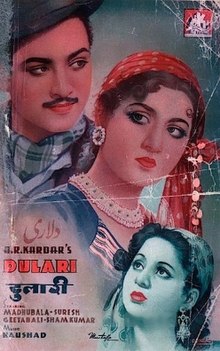
As you might have already understood from the poster, the female lead Dulari is played by the most beautiful lady of the silver screen, Madhubala and the actor is Suresh, whom I’ve never encountered or heard of before watching this movie. Geeta Bali is in a supporting role along with some other unknown names (you might find more on IMDb). The movie was a box-office hit and does have some famous songs from Naushad. I do not find anything worth mentioning about the movie, which shows a somewhat frightful time when city kids could be easily kidnapped by nomadic Banjara’s. That is the whole gist of the movie which only shows two classes of a freshly independent Indian society: the rich upper class and the nomadic tribals. And at the end how these both classes might perceive each other, the rich business man calls the tribals as shameless, vulgar, uncivilized people and the tribals talk of the rich city men as a living walking bag full of money. The suppression of women by both the classes is also quite evident. However, to listen to those nasal voices and dramatic dialogue delivery (which is an experience in itself), you can watch the whole movie on YouTube.
Let’s come back to the song now. The song is very short and laden with easy Urdu words with a very simplistic tune, sung by the nightingale of Bollywood Lata Mangeshkar and set with tunes by one of the most famous music directors of all time Naushad. It is a happy song sung by Dulari in the throes of love with dreams of a wonderful future life while she awaits her lover to make preparations for their marriage. It seems that no choreographer was hired for the movie (probably that was the norm at that time), as Madhubala lazily swings her arms and moves around in every song. You might say that was her whole idea of dance in the movie, to look pretty and dainty and nothing more than that (but then I would say, wasn’t this her dance style in almost every song ever filmed on her). And why not, Madhubala is beautiful enough to be able distract you from her lack of dancing skills! Enjoy the song here.
Female: Mohabbat hamari
Zamana hamara
Tu gaye ja aye dil tarana hamara
Mohabbat hamari, zamana hamara
Tu gaye ja aye dil tarana hamara
Mohabbat hamari
English: Love is ours
The era (or world) is ours
You, o heart, keep singing the songs of ours
Love is ours, the era (or world) is ours
You (my) heart keep singing the song of ours
Love is ours
Rahenge sada ham khushi ke chaman mein
Rahenge sada ham khushi ke chaman mein
Milega naa gham ko thikana hamara
Milega naa gham ko thikana hamara
Tu gaye ja aye dil tarana hamara
Mohabbat hamari
English: We will reside forever in the garden of happiness
We will reside forever in the garden of happiness
Sorrow will never find the address of ours
Sorrow will never find the address of ours
You, o heart, keep singing the song of ours
Love is ours
Ooooooooooo Hasin hai mohabbat hamare hi dam se
Ooooooooooo Hasin hai mohabbat hamare hi dam se
Naa bhulegi duniya fasana hamara
Naa bhulegi duniya fasana hamara
Tu gaye ja aye dil tarana hamara
Mohabbat hamari
English: Ooooooooooo love is beautiful only because of our might
Ooooooooooo love is beautiful only because of our might
The world will never forget the love story of ours
The world will never forget the love story of ours
You, o heart, keep singing the song of ours
Love is ours
Ham iss zindagi ko ujadane naa denge hoooooooo
Ham iss zindagi ko ujadane naa denge hoooooooo
Yahi zindagi hai
Yahi zindagi hai
Yahi zindagi hai khazana hamara
Tu gaye ja aye dil tarana hamara
Mohabbat hamari
Tu gaye ja aye dil tarana hamara
Mohabbat hamari
English: We will not let this life get ruined hoooooooo
We will not let this life get ruined hoooooooo
This life only is
This life only is
This life only is the treasure of ours
You, o heart, keep singing the song of ours
Love is ours
You, o heart, keep singing the song of ours
Love is ours
Glossary:
- Mohabbat: Deep love
- Zamana: Era or world
- Tarana: Song. In Hindustani classical vocal music Tarana is a specific kind of composition which is made up of words based on Arabic or Persian phonemes. This compositional style was invented by Amir Khusrau in the 13th Century CE and is similar to Qalbana form of sufi poetry.
- Sada: Always or forever
- Khushi: Happiness, joy
- Chaman: Flower garden
- Gham: Deep sorrow or grief
- Thikana: Address or whereabouts
- Hasin: Beautiful. It is usually a superlative idea of beauty, the closest translation in English will be extremely gorgeous.
- Dam: Life, breath or power
- Bhulna: To forget
- Fasana: A folk tale, story or legend. Mostly love stories.
- Zindagi: Life
- Ujadana: To ruin or root up
- Khazana: Treasure
 The Heritage Chutney